
We are living in an era defined by rapid technological leaps, with Artificial Intelligence (AI) leading the charge. Across the globe, businesses, healthcare systems, financial institutions, and governments are rushing to integrate AI into their core operations. This massive shift is widely known as AI Transformation. However, as organizations pour billions of dollars into machine learning, large language models, and data infrastructure, a critical mistake is being made. Many leaders view AI transformation as a purely technical challenge- a race to acquire the fastest algorithms, the largest datasets, and the most talented data scientists.
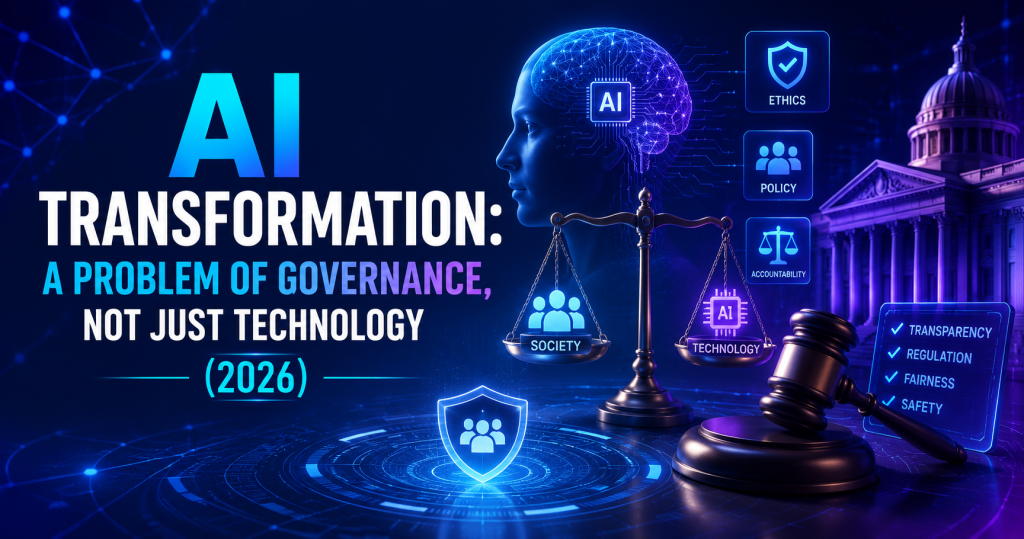
In reality, the biggest hurdle to successful AI transformation is not technical; it is a governance problem. Without a robust governance framework, even the most sophisticated AI systems are prone to failure, ethical disasters, legal liabilities, and operational chaos. To unlock the true potential of AI, we must stop treating it as an IT project and start managing it as a core governance priority.
1. Why Governance Trumps Technology (The Accountability Vacuum)
Most AI initiatives stall not because of coding errors or technical limitations, but because organizations treat AI like a traditional software upgrade. Traditional software is predictable; it follows pre-written, static rules. AI, on the other hand, is dynamic, autonomous, and continuously learning.
When AI systems are introduced without clear human oversight, they create an “accountability vacuum.” If an AI system makes a critical error such as misdiagnosing a patient or failing to flag a major financial risk—who is held responsible? Is it the developer who wrote the code, the team that collected the training data, or the business leader who deployed the system?
Without strict governance, organizations face:
- Shadow AI: Employees using unauthorized, unmonitored AI tools (like public LLMs) with sensitive company data, leading to massive leaks.
- Fractured Workflows: Teams working on isolated AI pilots that do not align with the company’s overall business strategy.
- Trust Deficit: Customers and clients losing faith in automated systems because they feel their data is not treated ethically.
2. 10 Essential Key Terms in AI Governance
To successfully navigate the landscape of AI transformation and outpace competitors, it is crucial to understand these 10 foundational concepts:
- AI Transformation: The strategic process of integrating artificial intelligence into all areas of an organization, fundamentally changing how it operates and delivers value.
- AI Governance: The framework of rules, ethics, and accountability structures designed to ensure AI is developed and deployed responsibly.
- Algorithmic Bias: Systemic errors or unfairness in AI outputs caused by biased data used during the model’s training process.
- Explainable AI (XAI): Methods and techniques in the application of AI such that the results of the solution can be understood by human experts.
- Data Stewardship: The management and oversight of an organization’s data assets to ensure high quality, security, and compliance.
- Model Drift: The decay of an AI model’s predictive performance over time due to changes in real-world environments and data patterns.
- Human-in-the-Loop (HITL): A model that requires human interaction, judgment, or oversight to make final, high-stakes decisions.
- GDPR Compliance: Adherence to strict global data protection and privacy regulations when collecting and processing user data.
- Corporate Governance: The system of rules, practices, and processes by which a firm is directed and controlled.
- Ethical AI: The development of artificial intelligence systems in a way that respects human rights, fairness, and safety.
3. The Core Governance Challenges in AI Transformation
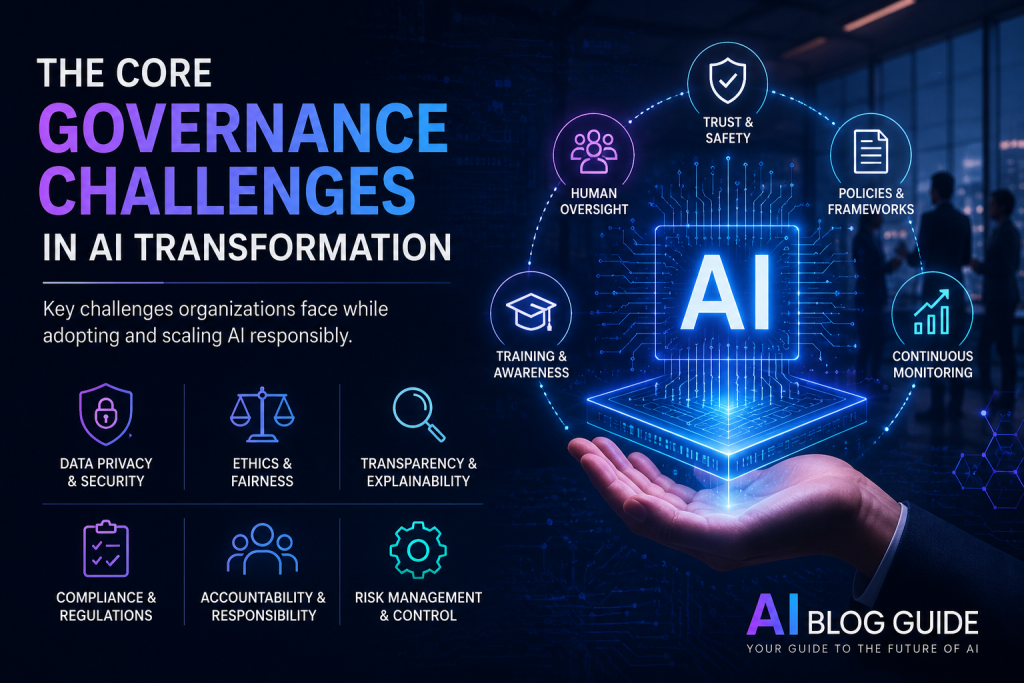
An effective AI transformation requires organizations to address several critical governance challenges. These challenges cannot be solved by writing better code; they must be solved through policy, oversight, and cultural alignment.
- Algorithmic Bias and Fairness: AI models learn by identifying patterns in historical data. If the historical data contains human biases, whether based on race, gender, socioeconomic status, or age, the AI will not only learn those biases but will also amplify them at scale.
- The “Black Box” Problem (Explainability): Many modern AI architectures, particularly deep learning neural networks, are highly complex. Even the engineers who built them often cannot explain exactly how an algorithm arrived at a specific decision.
- Data Privacy, Security, and Consent: AI relies on massive volumes of data to function effectively, much of which is highly sensitive personal information. With global regulations, mishandling data carries heavy legal and financial penalties.
4. The Consequences of Poor AI Governance in Business
In the corporate world, the rush to adopt AI without proper guardrails has led to highly publicized failures. Without structured governance, companies expose themselves to three main vulnerabilities:
- Reputational & Brand Damage: A customer-facing AI chatbot that generates offensive content or makes false promises to users can destroy a brand’s reputation overnight.
- Operational & Financial Loss: Inaccurate algorithmic predictions (such as real estate valuation or credit risk) can cause businesses to make disastrous, high-stakes financial decisions.
- Legal Penalties & Fines: Regulatory bodies are actively auditing AI implementations, and non-compliant companies face severe financial penalties.
5. How to Build an AI Governance Framework
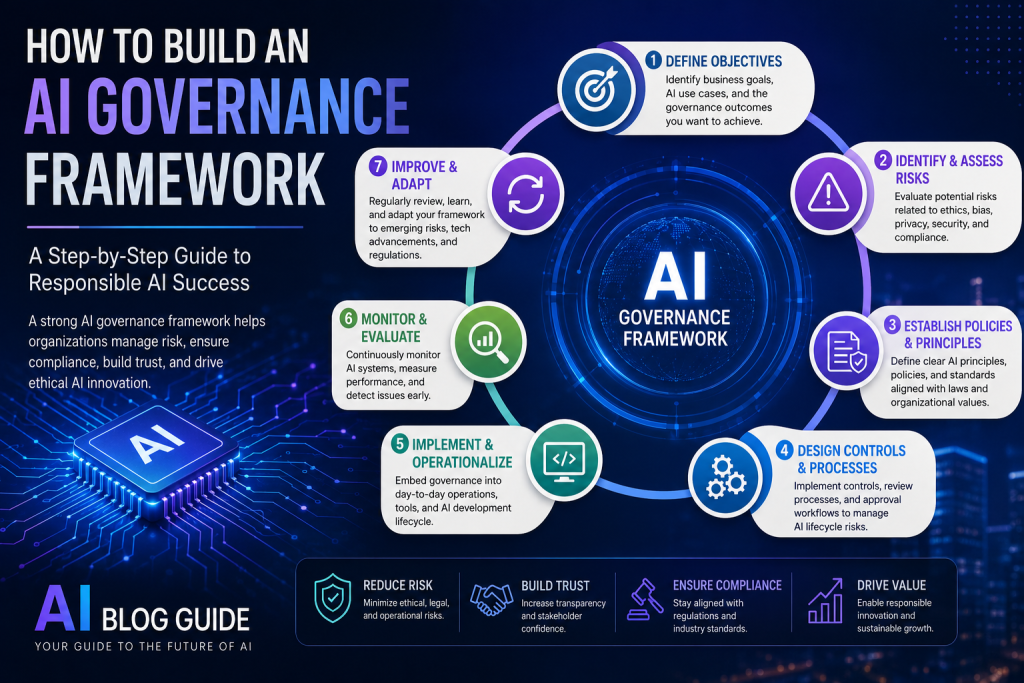
Achieving successful AI transformation requires structured steps to embed governance directly into the organization’s workflow.
1. Establish Ethical Principles: Phase 1: Foundation.
Define the core values that will guide your AI initiatives. These typically include fairness, transparency, accountability, safety, and privacy.
2. Create an AI Ethics Board: Phase 2: Structure.
Form a cross-functional committee consisting of data scientists, legal experts, business leaders, and ethicists to review, approve, and monitor AI projects.
3. Implement Data Stewardship: Phase 3: Input Control.
Establish rigorous data quality, security, and lineage tracking. Ensure all data utilized for AI training is ethically sourced and legally compliant.
4. Conduct Continuous Auditing: Phase 4: Lifespan Monitoring.
Do not treat AI deployment as a one-time event. Implement automated monitoring to continuously audit performance, bias, and security.
Conclusion
The promise of AI transformation is immense. It can streamline operations, spark unprecedented innovation, and unlock entirely new business models. However, treating AI transformation as a purely technical race is a shortcut to failure.
True, sustainable AI transformation occurs at the intersection of technology and humanity. By recognizing that AI transformation is fundamentally a problem of governance, organizations can build systems that are not only highly advanced but also trusted, ethical, and legally compliant. Technology is an incredibly powerful servant, but a dangerous master. The key to keeping it in check is, and always will be, robust governance.
FAQs
Q1: Why is AI transformation called a “governance problem”?
Answer: Because implementing AI is not just about technology; it involves assigning decision-making power to algorithms. Without strict rules (governance) to manage bias, security, accountability, and ethics, these automated decisions can lead to legal issues and business failure.
Q2: What is the difference between AI Governance and IT Governance?
Answer: IT governance focuses on managing software, hardware, and network security. AI governance goes much deeper, dealing with ethical choices, algorithmic fairness, data bias, societal impact, and the transparency of machine-made decisions.
Q3: How does algorithmic bias occur in AI?
Answer: AI learns from historical data. If the past data contains human prejudices or unfair trends (e.g., gender bias in historical hiring data), the AI will copy and amplify those biases, making unfair decisions at a massive scale.
Q4: What is “Explainable AI” (XAI) and why is it important?
Answer: Explainable AI refers to methods that allow humans to understand exactly how an AI model arrived at a specific output. This is vital in fields like healthcare and finance, where patients and clients deserve to know the reasoning behind life-changing automated decisions.
Q5: Can small startups afford to implement AI governance?
Answer: Yes, and they should. Startups do not need complex, expensive committees. They can practice basic AI governance by using clean, ethically sourced data, documenting their AI decisions, and ensuring human oversight is always involved in critical processes.
